Planetariums
On the centenary of planetariums, we discussed their mission and future with M.Sc. Damian Jabłeka, Deputy Director of the Silesian Planetarium and Science Park in Poland.
05. Feb 2024

The Silesian Planetarium is the largest and oldest planetarium and astronomical observatory in Poland. It is located in the town of Chorzów near Katowice. In 2023, it hosted some of the events as part of the International Olympiad on Astronomy and Astrophysics. We talked with the deputy director, M.Sc. Damian Jabłeka, who presented the Planetarium and its activities to us, and we also talked about the role of planetariums in modern times.
Mag. Damian Jabłeka, hello and welcome to our podcast! Before we dedicate ourselves to planetariums, we would like you to introduce yourself to the listeners first. What was your scientific path and how did you connect with the Silesian Planetarium?
My name is Damian Jabłeka and I am an astronomer. Life's path led me to now work at the Planetarium, where I also have some say in its further development. It all started when I was a teenager. I was doing well in school, but nothing particularly interested me. One day, after classes, my physics teacher advised me to find an interesting hobby. She pushed the book “The Sky in the Palm of Your Hand” into my hands, and that book actually changed my life. I read it quite a few times. In addition to describing the basics of celestial mechanics and the use of time in astronomical observations, the book also details individual constellations.
I was thrilled to have interests other than school. Because of that, I started observing the sky with the naked eye, using a star chart in the process. Then I bought my first telescope and became active in the high school astronomy club, competitions followed, and so on. Later, I started coming to the Silesian Planetarium together with the Polish Amateur Astronomers Association to build a large, half-meter telescope. High school enthusiasm led me to study astronomy, which I completed at the Jagiellonian University. Later, I started cooperating with the university and enrolled in a PhD program, but in the meantime, before I finished my studies, the then-director of the Planetarium, Lech Motyka, called me and asked if I already knew what I wanted to do after finishing my studies. He actually had a job for me. By some coincidence, while I was finishing my studies, a few people left the Planetarium, and thus a position opened up for me. While I was still cooperating with the university, I started working at the Planetarium, this magical place where we bring the secrets of the sky closer to our guests.
You are the Deputy Director of the Silesian Planetarium. It was established in 1955 in honor of the famous Polish astronomer Nicolaus Copernicus, who was born 550 years ago. Can you describe the history of your Planetarium? What were the beginnings and how many people were involved in the project at the beginning?
The Silesian Observatory was established in 1955 as the first such institution in our country. After the end of World War II, there was a great interest in Poland in establishing such a planetarium, as we had already known them before the war. At that time, while looking for a location, they discussed Warsaw, Kraków, and Wrocław. Also on the table was Katowice, which is the center of the Upper Silesian industrial region, and this was probably decisive for the establishment of the Planetarium in our town. In communist times, hard work was the highest value, so after work, the Silesians deserved culture and entertainment combined with science. Thus, at that time, Voivode Jerzy Ziętek decided to build a large recreational park, 460 hectares in size, including the Silesian Planetarium.
The construction of the Planetarium itself took only three years. The design is inspired by the architectural style of social realism, but the building itself, which resembles Saturn and its ring, is futuristic. It fits nicely into the microcosm of a dozen buildings in Upper Silesia that refer to space, much like Spodek—a multipurpose arena whose shape resembles a spaceship.
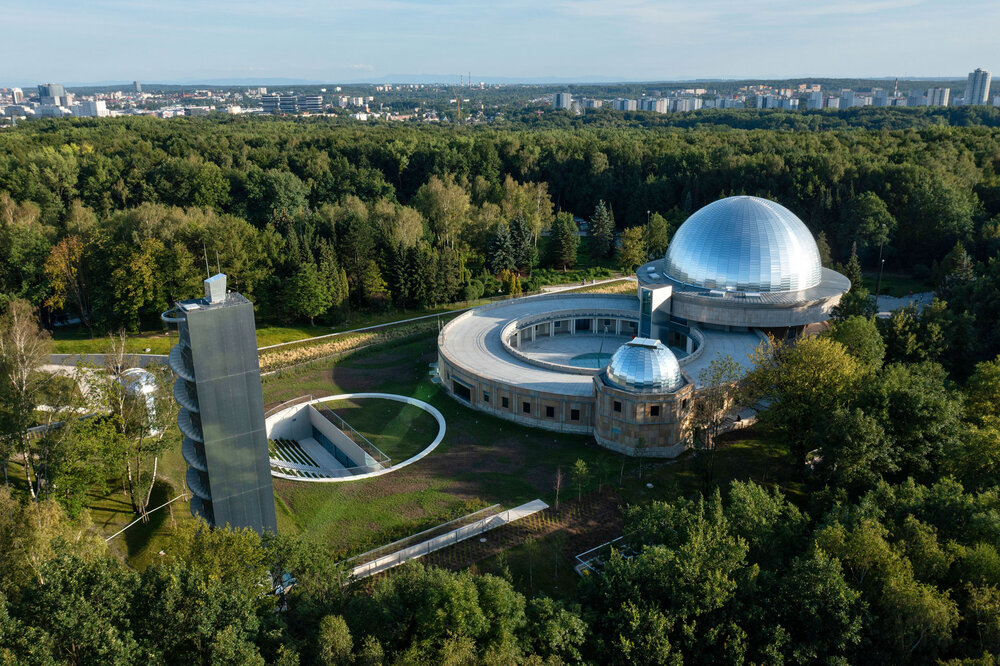
PLANETARIUM - SILESIAN SCIENCE PARK NEAR KATOWICE IN POLAND. PHOTO: SILESIAN PLANETARIUM.
From the time the Planetarium was built, similar to any construction site, numerous adventures are known. The most famous one features someone that I also know myself. Mr. Antoni once told me that as a teenager, he participated in building the Planetarium's screen. When the concrete dome was already built, they still had to construct the screen inside it. They made a metal structure and added a wooden frame to it, onto which they nailed the canvas with nails, where the stars were later projected. During construction, the entire Planetarium was surrounded by scaffolding, which was used for installing the screen. When the work was finished, the scaffolding was torn down, but because they were in a hurry, the waterproof coating on the inside was not yet finished. As luck would have it, a downpour arrived at that time, which was so heavy that water penetrated through the concrete dome and soaked the screen. Since the scaffolding was no longer there, Mr. Antoni climbed along the wooden frame between the screen's framework and the concrete dome, removed the ruined canvas, and installed a new one. According to his account, new rolls of canvas were transported for several kilometers on carts through the emerging park to the Planetarium and they built a new screen before its opening. Their effort made it possible for the screen on opening day to be new and pristine, enabling observations of the night sky.
During last year's International Olympiad on Astronomy and Astrophysics, which took place in Chorzów, Poland, I visited your Planetarium myself. I can confirm that its dome is truly huge! I was told that it is the largest dome in the country and has a diameter of twenty-three meters. The night sky projected onto the screen is spectacular, I truly enjoyed it. Next to the planetarium there is also a science center, a large sundial, and so on. Can you please describe the entire complex for those who have not yet had the opportunity to visit it?
The Silesian Planetarium, following a renovation that lasted between 2018 and 2022, has acquired a new form. We expanded it and gave it a new name: "Planetarium – Silesian Science Park". In the Planetarium, we now have a twenty-three-meter projection dome in a hall that accommodates three hundred visitors. With the help of a hybrid system consisting of an analog projector and a digital planetarium, we can simultaneously create an image of a completely dark sky—meaning a realistic sky from places that are not light-polluted—while at the same time we can upgrade this image with digital graphics of constellations and journeys into distant parts of the Galaxy. The Planetarium is thus a place for the education of children and youth, as well as a space where families with children can come for entertainment with lights and a touch of science.
In addition to the planetarium, there is also a science center here with two exhibitions—geophysical and astronomical. At these exhibitions, which are interactive, we learn and experience from various angles how our planet and also the entire universe work. In the planetarium courtyard, we also have a huge sundial, and near the Planetarium, there are three observatories. In the oldest one, which is connected to the Planetarium, there is a new telescope. Next to the Planetarium is a small observatory of the Polish Amateur Astronomers Association, affectionately called “the mushroom,” as well as “R2D2”. We also have an amateur telescope in the construction of which I was fortunate enough to participate myself.
The last, our newest observatory is a radio observatory: it is a five-meter radio telescope, which is also located right next to the Planetarium. The entire space, which was arranged after the reconstruction of the Planetarium, was built underground so as not to interfere with this historic building, which is an architectural gem in Silesia. Nevertheless, we doubled the space where we can share knowledge even better with visitors.
What significance does the Silesian Planetarium have for the region and for Poland?
The role of the Planetarium has not changed throughout its seventy years of existence up to the present day. We can say that its mission is to encourage passion, inspiration, and enthusiasm, as well as to bring the sky closer to people. However, if you think about it, the goal of the Planetarium is broader. It is about improving the quality of life for both the residents of Silesia and other visitors. How? In my opinion, we do this by showing people complex, distant, and unimaginable phenomena—those that usually do not interest us in everyday life and that are also inaccessible. We encourage people to acquire knowledge and to think about the entire Universe. Through this, generation after generation of people acquire more knowledge, and with personal growth and care for the environment, the quality of our lives also increases. If we understand something better, we are also more satisfied with ourselves. We become more aware that we are part of the Universe. For the same reason, we organize educational courses. We are aware of the importance of natural sciences, geography, physics—of the work that we can show on our sky. Presenting astronomy on a flat screen is difficult and requires a lot of imagination. Presenting it on a large hemispherical screen directly presents all the phenomena, processes, and relationships in the sky, and this enables children to develop faster and have a better life.
As a Planetarium, we organize the national Astronomy Olympiad every year. Several hundred young people from all over Poland participate in it. Usually, twenty of them qualify for the final, and then we select a few laureates from among them. The first five can participate in the international olympiad. The Planetarium also organizes other competitions, such as the local Astronomy and Astronautics Competition, and participates in other cultural events, such as relaxing concerts. These are illustrated with graphics on the Planetarium's dome and provide a short break from the gray everyday life, while giving us more energy to change our lives, for growth and enjoyment in what surrounds us. We organize various scientific conferences, as well as the Cosmicon fantasy convention, where enthusiasts of fantastic literature, scientific culture, and the combination of science and fantasy gather.
Do you also conduct scientific research at the Planetarium?
In our Planetarium, many people are employed who have extensive experience with scientific work. However, currently our staff does not conduct scientific research. We hope this will change soon. For many years, the Planetarium conducted research on our planet, specifically seismographic research. Namely, we have seismographs and seismometers that measure the movements of our planet's crust, seismic movements, as well as ground shaking caused by mining. Mining is very widespread in Upper Silesia, and ground shaking due to anthropogenic causes is therefore a common phenomenon here.
Near the Planetarium is a meteorological station, where we have been taking daily measurements of atmospheric conditions for fifty years. This allows us to understand how the climate of the Silesian Park is changing. With the help of these measurements, we have already published quite a few scientific articles.
The Planetarium also includes two observatories—an optical and a radio one. The optical observatory has existed for quite some time, and a huge amount of research has already been conducted there, mostly in the field of the position and brightness of small bodies in our Solar System, i.e., asteroids and comets. However, our old telescope no longer met scientific standards by today's criteria, so we recently replaced it with a new and larger one, with which we will resume scientific research, also in the field of celestial bodies. We already have some ideas for this research in the optical part, mostly concerning the study of the variability of star brightness and small bodies in the Solar System, and in addition, we could also research gravitational lensing or search for exoplanets. But these are plans for the future.
With the radio telescope, we will try to assess the radio variability of our Sun, or determine the distribution of hydrogen in our Galaxy. But the telescope is small, with a diameter of only five meters, so its main role will be of an educational nature.
The Planetarium is closely connected with the science center. Do you also present the latest discoveries and research results, both local and international, to visitors at the Planetarium?
The Planetarium - Silesian Science Park - is a single institution. It is a single building that hosts both the Planetarium and the science park. Last year, it had approximately half a million visitors, which is a huge number! Of these, half viewed the projections in the Planetarium, while the other half visited the exhibitions or other events and workshops.
During a visit to our institution, people become acquainted with the latest discoveries. Every projection in the Planetarium hall begins with a fifteen-minute live introduction to the current state of the sky. Our lecturers do not talk only about the constellations currently in the sky, but also about other latest interesting facts related to observations, astronomy, and space exploration.
Visitors can learn even more about the latest scientific discoveries at our exhibitions, as they are always guided. Our guides not only take us through the exhibition, but also lead us on an educational path while weaving a story that helps us understand the process through which we gain knowledge about our Earth and understand the processes happening both on Earth and throughout the universe.
What activities can visitors participate in at your science center? How many people are involved in developing and preparing new activities? Can you tell us what new activities you are preparing for the future?
The exhibitions in the Planetarium – Silesian Science Park are primarily focused on experiencing physical processes or their effects. Our visitors can use the earthquake room, where they experience a realistic simulation of an earthquake. They can also feel different climates when entering rooms with the same temperature but different air humidities. In one, the humidity reaches ninety percent, while in the other it is only thirty percent. We simulate this in both cold and hot climates. Visitors can therefore experience that temperature is not the only main carrier of our experience, but also humidity and wind. All these aspects affect how we experience the cold. We can see a tornado a few meters large, and a two-meter lightning bolt that strikes a model of the city of Katowice. On a large model of the Earth, we show how continents moved in the past and how seismic waves propagate. We can learn about what the cross-section of our planet looks like, and how seismic waves propagate. We can try our hand at building a city in a seismically active place. Then we turn on the seismic activity and check which young engineer best understands earthquake-safe construction. All of this can be found in the geophysical section.
In the astronomical section, we can walk through space in a three-dimensional display. The evolution of stars is on display there, and we can also look through a telescope ourselves or use a coelostat. We see how such a telescope works, and at the end, they present the spectra of various elements and show us traces of particles from space flying through us.
The highlight of the astronomical section is the old Zeiss projector. This is a monumental projector that we used for a huge amount of time, from 1955 to 2018, for projecting stars on the planetarium dome in an analog, optomechanical way. Today it is located in the center of our science park and is still functional. They built it so well that it still works.
We have about thirty guides employed. For now, after the expansion, due to limited funds, we are not planning changes to the exhibition. We are thinking about alternative ways of guiding that would enable participation even for those who need adjustments. We are developing education for young children, choosing only certain topics and presenting them in a way appropriate for them. We are also developing a range of workshops and short lessons in which children and youth can participate. At these workshops, they learn and try to solve a specific problem—they find out how to tackle it and what they can learn in the process. The workshops are limited to the three areas we deal with, namely astronomy, seismology, and meteorology. We combine the latter two areas and show them at the geophysical exhibition, while astronomical phenomena are shown at the neighboring astronomical exhibition.
We allow visitors to use a space flight simulator, where we board fantasy capsules. Virtual reality and the movement of these capsules take us on a space flight that feels almost real. You can also visit the tower, from where you can admire the Silesian landscape, but not in the usual way. With a moving mirror and lenses, the panorama is projected onto a table in a dark room. This is a completely different experience from looking out the tower window.
In addition to participating in activities in the planetarium dome, students have the opportunity to observe the sky with telescopes. How concerning is light pollution at the Planetarium's location, and what is the situation in the country?
Our institution has observatories that will soon be ready for use. By Polish standards, we have a huge telescope with a diameter of seventy centimeters. The telescope has a special design with a third, rotatable mirror. It is built in such a way that we can observe in both focal points, or carry out observations on both sides of the telescope's mount. This is achieved with the simple press of a button, which causes the tertiary mirror to pass the image to one side or the other.
One side of our telescope is prepared for scientific research, which includes a filter wheel, camera, rotator, focuser—all the elements we need for scientific imaging of the sky. On the other side, however, is an eyepiece, where anyone among us can observe with their own eyes.
With such a large telescope, you can even observe bright stars during the day, not to mention Jupiter and Venus, provided they are far enough from the Sun. At night, we can observe the full beauty of our universe. With such a large mirror, we achieve enormous resolution, which means we can observe even the smallest details on the Moon, on the planets, and we can also peek into deep space and view galaxies, star clusters, or gorgeous nebulae.
Of course, we are in the center of Upper Silesia, a place with very high light pollution. Fortunately, in modern astronomy, by using narrowband filters, we can still engage in science, image the night sky, and create beautiful, colorful images. Our visitors do not see a completely dark sky, but the interaction with such an astronomical device and the simultaneous observation of even basic objects, such as the Moon, is impressive, as the high resolution leaves a deep impression. Observing can also be a deep emotional experience for those who, for example, see a globular star cluster through a telescope for the first time. These are incredible experiences, and that is why we decided that despite light pollution, we would first build this device, which will be used both for scientific research and to give people the opportunity to visit a real astronomical instrument used for scientific research, with which they can also observe themselves. Usually, such instruments are located high in the mountains or in hermetic observatories that are difficult to access. But we are focused on cooperation with people, our visitors, and therefore our observatory is open for visits.
How does your audience view the role of planetariums?
We receive very positive impressions and feedback from our guests. On social media, we get many positive reviews, as well as via email and regular conversations with our guests, both individual visitors and chaperones of school groups. The responses from young people are also very positive. Our other cultural events, such as Cosmicon or the concerts, are well received. Because of this, we enjoy a great reputation in the local community. Many people remember our Planetarium from the times when they came here as children in elementary school. Today, they return as teachers or parents with their children and are surprised by how much the Planetarium has changed and expanded with the inclusion of the science center. They like coming to us. We want the interest in our Planetarium to remain high, and every day we strive to do everything in our power for our guests.
Are the experiences in the Planetarium based on Greek or so-called "Western" constellations, or do you also incorporate interpretations from other cultures and their stories connected with the stars?
Human interaction with the night sky is inherently a deep experience. Darkness and the stars alone are enough to feel joy, which can sometimes turn into unease or even fear. We fear the foreign, the unknown, that which we cannot name. That is why, since ancient times, cultures have named the objects in the sky. They connected points that nature randomly distributed into various shapes they knew, such as gods, heroes, or everyday objects.
Today, we present the world of astronomy to people in the exact same way. We always introduce our guests to the stories of the constellations currently visible in the sky. We tell them which constellation the Moon is currently in, where to find the planets, and how to distinguish them from stars. In Europe, Greek astronomical culture predominates. We use the division of the sky into eighty-eight constellations approved by the International Astronomical Union. However, in particularly interesting stories, we don't just explain the European perspective; we also present Arab legends or tell where the names of the stars come from. Sometimes we even reach into more distant cultures. For example, I often mention that certain South American cultures see a turtle in the constellation Orion.
"In our Planetarium, of course, Polish culture is not lacking. We usually emphasize constellations placed in the sky by the Polish astronomer Hevelius, such as Scutum Sobiescianum (or the constellation Scutum), as well as the stories of Lel and Polel, which are the Polish version of the Roman twins Castor and Pollux and typically appear in our Slavic stories. We also like to emphasize that the sky belongs to everyone who wishes to get to know it."
Despite that, we focus most on the scientific part. Our lecturers do not just talk about a certain star being, for example, someone's foot, or someone else's hand or head, but we emphasize that over the last few centuries we have gained an enormous amount of scientific information about these stars. Practically all constellations hide some discovery, whether it is the observation of Uranus or Neptune, the first supernova, understanding distances in space, or the first radio bursts observed in a certain part of the sky. If we know where all this happened, we can visit these constellations and explore these phenomena together with our visitors. On one hand, we present the Greek culture in the sky, which is in general use so that we do not feel like strangers and do not arouse fear, while on the other hand, we emphasize cultural diversity. At the same time, we draw upon the oldest observational culture—the culture of discovery and the development of knowledge based on the sky.
What, in your opinion, is the role of planetariums today? Is the "wow" effect important for the audience? Do you think that young people are more attracted to the night sky after visiting a planetarium?
In today's times, we have the opportunity on our home computers to view various simulations with the help of powerful graphics cards, but despite technological progress, the role of planetariums has actually grown. There are several reasons for this, the main one being the effect with which we, the creators of planetarium content and guides through the vast knowledge of the internet, curate selected content. This content is only a small fraction of all knowledge, and we want to present it in a way that is clear and understandable. I believe this is the main advantage of all institutions operating in this way. Everyone might ask why they should visit an institution when they can view everything on the internet. The answer is that it is impossible to view everything. On the internet, we can only look at small fragments of knowledge at a time, and searching for these small pieces can take more time than reading or viewing itself. Therefore, it is better to go to an institution that already prepares and organizes all of this for us in a clear and understandable way. Such a role of the planetarium is very important in our digital, modern world. Of course, even a large, twenty-three-meter screen cannot compare to even the largest television or projector. The experience of an almost authentic sky coming from an optomechanical projector—meaning bright points of light in a completely dark sky, enriched with intergalactic flights or flights through our Galaxy to other planets—evokes a deep interest in the content. Inside such a large dome, we feel as though we are truly in a three-dimensional universe, and all of that without 3D glasses.
"The role of planetariums is also growing because we are living in a space age once again. In a way, a repeat of what happened in the 1960s and 1970s is taking place, when we were fascinated by the conquest of space. This was expressed both in science, in human development, and in culture, music, and art. It seems that we are now entering a period of civilization that is lost in space. More and more frequently and boldly, we are thinking about human visits to Mars, the return of humans to the Moon, and the construction of better, reusable spacecraft. Consequently, this is a very good opportunity for the popularization of astronomy that we must not miss."
We must keep pace with the needs of our audience and ensure that they do not succumb to misconceptions and oversimplifications of the problems associated with space flights, or the reasons why we are returning to space and sending spacecraft there. It is also important to be aware of why we are building huge telescopes. For example, we are right on the verge of understanding the structure of the universe on large scales. In this regard, space telescopes, and soon the largest telescopes on Earth, allow us a glimpse into the cosmic dawn, the moment when the first galaxies were born and the first stars lit up within them. This will greatly improve our understanding of the development of the entire universe and the evolution of cosmic structure on large scales.
All the progress we are witnessing in the times we live in should be used for communication, so that people feel better, more comfortable, grow personally, and at the same time develop together with humanity. I see the role of planetariums today as a scientific space where our guests come, perhaps not even with the intention of acquiring knowledge, but to feed their senses and enjoy the beauty of the sky and celestial objects. They come so that someone can show them what the sky and the universe look like, or simply because the planetarium offers them pleasure in interacting with the night sky and science.
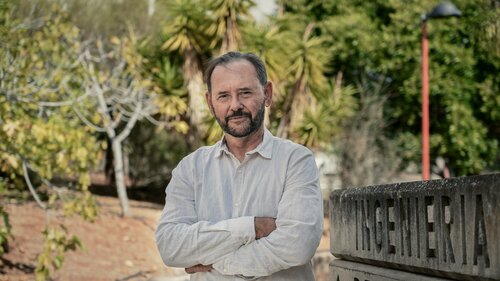
Cover: Mag. Damian Jabłeka. Image credit: Silesian Planetarium.