Glowing Worlds
What happens when a new star is born over millions of years, but in the end, it fails to ignite? Eduardo Martín described to us the turbulent events behind the discovery of the first brown dwarf.
03. May 2026

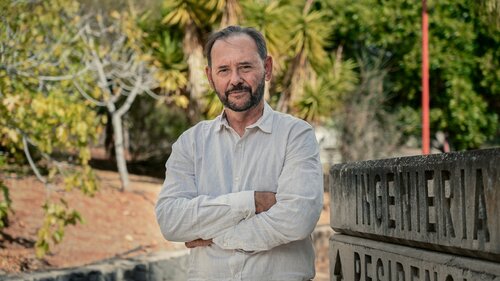
Eduardo Martín is a professor at the Institute of Astrophysics of the Canary Islands. He is one of the pioneers in brown dwarf research, having been a member of the team that discovered the first one a little over thirty years ago. He currently leads a European Research Council (ERC) project titled Substellar, which uses data from the Euclid space telescope. The goal is to map and study a large number of brown dwarfs in our Galaxy.
What are brown dwarfs, or "failed stars"? Why are they named that way?
Brown dwarfs were predicted in the 1960s by the American physicist Shiv Kumar and Japanese astronomers Takenori Nakano and Chushiro Hayashi. The latter is known for the so-called Hayashi tracks, which describe the evolution of young stars before they reach the main sequence. These astronomers found that due to quantum phenomena, there is a lower mass limit for a star belonging to the main sequence. As an emerging star contracts, its matter becomes heavily compressed and ionized, suddenly yielding a massive amount of free electrons. If compression continues further, it encounters a limit due to the Pauli exclusion principle, and the electrons respond with a repulsive force. This is not an electrical (Coulomb) force, but a quantum-mechanical one—though physically distinct in origin, it is stronger and can halt gravitational contraction. This means there is a limit to how far the core of an emerging star can contract.
Hydrogen, created during the Big Bang, is the most abundant element in the universe, making it the primary constituent of all stars. Young stars shine because a fusion reaction begins in their cores. The cores heat up to very high temperatures due to gravitational contraction. When the temperature rises above approximately three million Kelvin, the action of the strong nuclear force is sufficient to trigger the fusion process that binds hydrogen atoms into helium nuclei. In this process, a fraction of the mass is lost, as a helium nucleus has a slightly lower mass than the hydrogen nuclei from which it formed. According to Einstein's famous equation E=mc2, the conversion of even a very small amount of mass, multiplied by the square of the speed of light, yields a huge number—and thus a vast amount of energy. In this way, a very small amount of mass can produce enormous energy, which is how our Sun and all other stars shine.
However, there is a lower mass limit for this process. Stars with increasingly lower masses require longer periods—millions or even a hundred million years—for their cores to heat up enough to trigger nuclear reactions. Two competing phenomena are at play: on one hand, this process takes longer, and on the other hand, the cores of these objects must be more compact or denser. Because they have lower mass, the layers above the core weigh less, and therefore the contraction process takes longer. At a certain point, it reaches the limit known as the degeneracy boundary, where quantum phenomena take over. From that point on, matter no longer behaves normally. Ordinary matter follows ideal gas equations: if you increase the pressure, the temperature also increases. But degenerate matter behaves in the exact opposite way: such a gas cools down upon contraction instead of heating up. The more such matter contracts, the stronger the repulsive force becomes. When the degree of degeneracy becomes too great, there is no longer any possibility for a star to form. Instead, a degenerate object is formed that is incapable of sustaining stable hydrogen fusion. It never becomes a star, and is therefore sometimes also called a "failed star".
"Sometimes, when such objects were not yet known and were only theoretically predicted, they were often called 'black dwarfs'. Then, in the 1970s, astronomer Jill Tarter named them brown dwarfs in her doctoral dissertation. Although her mentor snapped at her with the now-famous words that 'brown' is not a good choice because it is not a color at all, she persisted, and the name stuck. There are also variations. In Mexico, for instance, the color brown is called café, so they have coffee dwarfs, which I especially like."
Us too! Brown dwarfs therefore form from the same cloud of gas and dust as stars, except they have too little mass for nuclear reactions to take place inside them. They are not stars, then, but something else.
That is correct, they are something else because they behave differently. In a simplified picture, we can imagine molecular clouds, which are huge clouds of gas and dust. In images of beautiful spiral galaxies, for example, we see a vast number of nebular regions. These are gases and dust where stars form. If nothing were to disturb the balance in these nebulae, stars would never form. However, there are shocks and interactions that disturb these clouds, and gravitational contraction takes place there. For example, we can imagine a glass sitting on a table in equilibrium. If we accidentally knock it over and it falls to the ground, it shatters. Some fragments of glass are large, others are medium-sized, but most are very small, sometimes even so small that you cannot see them. A molecular cloud in a galaxy behaves just like this glass floating in space. Then something knocks it over and shatters it. Massive stars will form from the largest fragments, which can even destroy the molecular cloud. After some time, they can even explode as supernovae. But most stars have a low mass, smaller than the Sun. Brown dwarfs are at the extreme end of these small fragments.
In the 1950s and 1960s, brown dwarfs were theoretically predicted, and then astronomers began searching for them in the sky. In 1995, you were part of the team that discovered the first brown dwarf. We are interested in the behind-the-scenes story of how the search unfolded and how you discovered it.
At the beginning of my career at the Institute of Astrophysics in Paris, with my advisors Claude Bertout and Gibor Basri, I started working on pre-main-sequence stars. This is the phase between the formation of protostars and the moment they settle onto the main sequence, where hydrogen fusion takes place. After two years, I returned to Tenerife, where I am from. There I began my PhD, which lasted three years. I wanted to continue with the same topic, but I shifted my focus slightly. My advisor was collaborating with an Italian postdoctoral researcher who was interested in very young, very low-mass stars. Together we went on an observing run with the Isaac Newton Telescope in La Palma. At that time, it was one of the largest telescopes in the world with a 2.5-meter mirror diameter. It had been moved to La Palma from the Royal Greenwich Observatory in London. We had an observing list that included T Tauri type stars, and also some visual binaries. In the control room, we had a screen showing which stars were in the field of view of the telescope. We were using a long-slit spectrograph. We got the idea to move and rotate the slit so that we could observe both stars simultaneously. In this way, we would save time and observe more stars. That is how we observed the UX Tau system. This is a known visual binary, and the stars are separated by about 6 arcseconds. Observations under normal seeing conditions are therefore comfortable. But that night it was very dark, and the seeing was very small. While observing the aforementioned screen, the telescope operator said: “Hmm, I think I see a third object… Is that possible?” With surprise, we also realized that there was something else there that we hadn't expected. It was a third, fainter object located between the two known stars, but closer to the brighter one. We immediately searched known catalogs on the internet, but found nothing, so we thought it was something new. We abandoned our original observing plan and asked the operator to point the telescope at this new object. We performed all sorts of possible spectroscopic observations, and so we spent the entire night, as well as the next one, observing this object. We were very excited because we thought we had discovered a new object. Later it turned out that this wasn't entirely true. In the catalog, we found a short comment where George Herbig noted that from the Lick Observatory on a night of good seeing with the 3-meter telescope, he had observed a faint object near UX Tau A (the brighter star). The discoverer was therefore him, but we were the first to obtain an optical spectrum. Analysis of the spectrum showed that it was a very cool object. Some theoretical models predicted that its mass could correspond to a brown dwarf. The object could therefore be below the substellar boundary we discussed earlier. This is a mass corresponding to about 80 Jupiter masses. But there were discrepancies among different models. Some predicted a mass above, and others below the substellar boundary. Thus we realized that we had a brown dwarf candidate, but the estimate of its mass depended on the model and could not be unequivocally confirmed. But it awakened our interest and shifted our focus.
We also realized that it is very difficult to distinguish between a very low-mass star and a brown dwarf. When such a star is very old, it can be very cool, while young brown dwarfs can be fairly warm. In fact, according to theoretical predictions, the temperatures of young brown dwarfs and very low-mass stars overlap. Therefore, estimating temperature does not make it possible to distinguish between a star and a brown dwarf at this boundary. We need something else. This problem troubled us, and so we came up with the next idea. The substellar boundary is actually a question of whether an object burns hydrogen or not. Fortunately, there is an element that ignites before hydrogen, meaning at a slightly lower temperature. Thus, any young object from which a star will form burns this lighter and more sensitive element. I am speaking, of course, of lithium. Thus we invented the lithium test and began testing. We traveled the world, from Chile to Hawaii and the Canary Islands, and observed with the largest telescopes in the world. In brown dwarf candidates from the literature, we searched for traces of lithium, but found nothing. We observed everything we found in the literature, but could not confirm even a single one. None showed signs of lithium preservation, which we had determined to be a characteristic of brown dwarfs.
This was between 1991 and 1994. In 1994, an international conference was organized in Garching near Munich, where the headquarters of the European Southern Observatory is located. The title of the conference was “The Bottom of the Main Sequence - And Beyond”. It is true that this was still a small community at the time, but everyone was there! And all search reports were negative. The conference was very depressing. Our group reported on the lithium test—all negative. Geoff Marcy reported on searches using radial velocity measurements, but found nothing. Some theorist colleagues even predicted that brown dwarfs do not exist at all. They believed that there is too much heating in the cores of emerging stars, and that the mass limit down to which stars can still form is above what we now call the substellar boundary. According to this theory, brown dwarfs therefore do not exist. That was the conclusion of the 1994 meeting. The following year, the discovery of the first exoplanet around a Sun-like star was announced, along with the first brown dwarf in the Pleiades cluster, and the first brown dwarf in a pair with a nearby red dwarf! All of this one year after that depressing conference. One year after the conference, the discipline of substellar objects completely exploded.
"We were also part of this game—we discovered the first indisputably confirmed young brown dwarf in the Pleiades. It was one of three major discoveries, and all of them were announced at a single meeting, specifically at the Cool Stars conference in Florence in October 1995. Michel Mayor and Didier Queloz had a paper that was accepted by the journal Nature, but at the time no one knew about it yet, except of course the two of them, the conference organizers, and the reviewers. At that conference, they therefore caused a major sensation with the announcement of the discovery. We announced the discovery of our brown dwarf in the Pleiades during an invited lecture. Of course, it wasn't as big a sensation as the discovery of 51 Pegasi b, and that is because we are human, and as such we are biased. We think that a planet around a Sun-like star is much more important than a brown dwarf in the Pleiades. This is a very subjective opinion, because we are naturally interested in whether we are alone in the universe. The discovery of a planet around a Sun-like star was immediately linked to the search for life and big questions about whether extraterrestrial life exists. The next day, the Italian media even published Martians on the front page. It was a huge sensation."
At the same meeting, a colleague from Caltech was working on his laptop. Suddenly, he stood up, interrupted the conference, and started shouting: “They discovered a brown dwarf in a binary system with a red dwarf—and it's from Caltech!” The paper wasn't out yet, but that is how we found out about Gliese 229B, right there at the same conference. It was truly extraordinary!
Why were we the first to detect the brown dwarf in the Pleiades before anyone else? We weren't the only ones searching, after all. The Pleiades were actually known as a popular "hunting ground" for brown dwarfs. Astronomers such as John Stauffer were searching for them in the early 1990s using deep images and found several candidates. Astronomers from Hawaii were also looking—for example, Eric Becklin published a paper with candidates. Then there was the British group from the University of Leicester, led by Richard Jameson. They used the Isaac Newton Telescope—the exact same telescope we used to observe UX Tau and check for the presence of lithium. All these groups were acquiring deep images of the Pleiades and looking for faint objects. Our approach was different in that we acquired another image taken some time later. This was crucial because it allowed us to measure the proper motions of the stars. This was the decisive measurement we had ahead of others. We thus re-observed some fields that the British group had already observed about four years before us. With such a time baseline, we found an object that was very faint, but had a proper motion matching that of the cluster. This object was so faint that all models predicted it had to be a brown dwarf with a mass of around 50 Jupiter masses. That is well below the substellar boundary. Because of this, we were the first to have confirmation of a photometric candidate via its proper motion.
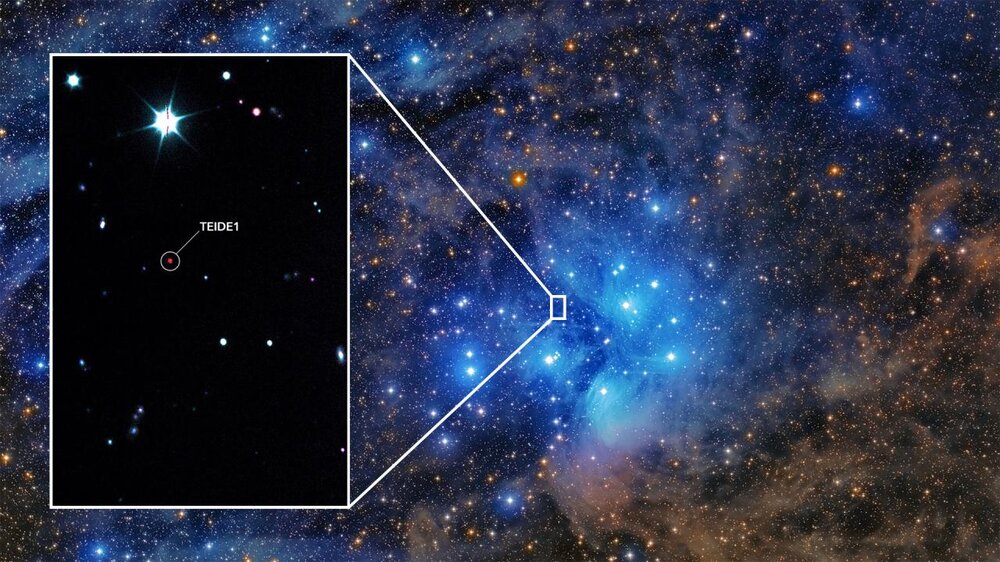
THE FIRST DISCOVERED BROWN DWARF, Teide 1, IN THE PLEIADES CLUSTER. PHOTO: Gran telescopio Canarias, Daniel López/Alfred Rosenberg, IAC.
That is an invaluable insight into the processes that lead to scientific discoveries.
I can share even more. There are two things that I like very much. First are the rumors I heard from colleagues of Richard Jameson. When he heard about the discovery of our brown dwarf, he called the student who was in charge of analyzing their data and asked him: “How could you miss this object? Were you drunk?” This object wasn't actually on their list of photometric candidates at all. They missed it, even though it was on their images. It was indeed on the edge of the detector, but it wasn't in the photometric catalog they published. So that is one amusing anecdote involving Richard Jameson, who was otherwise a refined gentleman. I hope he still is. I think he is retired now, but I haven't heard from him in a long time. But I imagine he was quite furious because this object wasn't even on their list of candidates.
The second interesting, or rather funny story, is about the American group. Geoff Marcy and Paul Butler were searching for exoplanets and reported negative results one year before the Swiss team's discovery. In fact, they had discovered a hot Jupiter—a Jupiter-mass planet very close to a Sun-like star. In their data, they found two hot Jupiters that they could have published in 1994. They had the data, but they did not analyze it properly. Due to theoretical predictions, they did not expect that a planet—a hot Jupiter—could be so close to a star. They were collecting data and thought they would analyze it ten years later, because a Jupiter-mass planet should have a long period. The Swiss team started later and discovered the first planet, even though the Americans had the data before them. Geoff once told me that that was how they lost the Nobel Prize. And that really happened, the Swiss team won the Nobel Prize, and the two of them did not.
The first brown dwarf was discovered in the Pleiades cluster. This is a young cluster where stars formed recently. Was this the reason you looked for brown dwarfs right there?
Yes. The Pleiades are young, but not so young that there is still a lot of interstellar extinction or leftover material from star formation. They are old enough for the interstellar dust to have cleared out. We therefore have a clear view of the Pleiades, and besides that, they are very close to the Sun—in fact, they are one of the closest open clusters. Because of this combination, they were the most popular hunting ground for multiple teams, as we weren't the first to look for them in the Pleiades. We were the fourth or fifth group, but our research built upon the work of our colleagues. We came up with the idea of confirming the brown dwarf's membership in the cluster via its proper motion, which must match the cluster's proper motion. This was the crucial factor that convinced the scientific community that our object truly belonged to the cluster. And that is because membership in a cluster allows you to estimate the object's age. Age is decisive, because only by knowing it can you distinguish between brown dwarfs and very low-mass stars. As I mentioned earlier, very old, very low-mass stars can look just like very young brown dwarfs. There is therefore an ambiguity that we dispelled by confirming membership through proper motion.
A few years later, we realized that we could find certain indicators in the spectra of brown dwarfs that can be used to estimate surface gravity. Through the spectrum, we thus estimate not only temperature, but also surface gravity. If the gravity is small, then the object is a brown dwarf because it has low mass and is young. Young objects are somewhat larger because they are still in the early stages of contraction. The combination of youth and sub-stellar mass results in lower gravity on the object's surface. Then there are details in spectroscopic indicators that are sensitive to this. We developed this methodology after the lithium test and the proper motion method, and it is a well-established tool in brown dwarf research today.
We know different types of stars. Some are hotter than the Sun and look blue, while cooler ones are red. What about brown dwarfs—are they all the same, or do we have different types there as well?
Brown dwarfs are very diverse, just like all objects in nature. Nature is diverse, and brown dwarfs are no exception. Many people research them, and research groups are now larger and more numerous. New sky surveys and new capabilities have allowed us to make progress in understanding brown dwarfs and also to realize that different types of brown dwarfs certainly exist. The community has devised various classification methods that take diversity into account.
In the late 1990s, this research discipline developed very rapidly. In 1994, we knew neither brown dwarfs nor exoplanets, but a year later both types of objects were discovered. By 1997, we already knew several brown dwarfs and a few exoplanets, and we noticed that both were diverse. One of the first things we noticed was that the spectra of the first brown dwarfs were different from stellar spectra. The stellar spectral classification system is over a century old. It was developed by Annie Jump Cannon at Harvard, and it remained that way for almost a century. The classification is the famous sequence of letters OBAFGKM, with the letter M denoting the coolest stars. Some brown dwarfs had spectra that differed from M-type dwarfs because they are cooler. Since they do not undergo fusion and are not stable, they cool down. We checked which letters were not yet used in the classification system, and there were a few choices (editor's note: for example, Table 5 in this article). The letter L was the most obvious choice for several reasons—including because my middle name starts with that letter. I'm kidding [laughter]. So in 1997, we decided to name them L-type dwarfs, and a year later, through in-depth research, we found the first one in the Pleiades. In 1999, a breakthrough came with the discovery of dozens of L-type objects in data from the 2MASS sky survey (research led by Davy Kirkpatrick) and in data from the DENIS sky survey, led by a European team. Thus, in 1999 we discovered many brown dwarfs and named them L-type dwarfs.
A few years later, fainter objects were detected in deep images and a new kind was observed. They were named T-type dwarfs. They are cooler than L-type dwarfs and so cool that methane molecules dominate their atmospheres. This is not observed in L-type dwarfs because they are not cool enough. The spectrum of T-type dwarfs is quite similar to Jupiter's. In fact, the spectrum of the brown dwarf discovered in 1995 around the nearby star Gliese 229 was similar to Jupiter's, but we didn't understand that well at the time because it was the only known example. By 2000, we already knew many objects that were cooler than the L type, and so we added a new letter to the classification scheme: T. Within a few years, we thus added two new letters to a classification system that was over a century old. Recently, another letter was added for objects that are even cooler. Their temperature is similar to Earth's, meaning these are room-temperature brown dwarfs. We call them Y-type dwarfs.
So those are the three types of brown dwarfs and their main differences. However, they also differ in details, such as chemical composition. Those that are metal-poor are called subdwarfs, extreme subdwarfs, and ultrasubdwarfs, depending on just how poor they are.
Brown dwarfs form alongside stars in large numbers. How common are they in our Galaxy compared to stars? How many do we know near the Sun? Can they at least partially explain the missing invisible matter, such as dark matter?
Brown dwarfs have always been among the candidates for dark matter in galaxies, but their currently known number is not large enough to explain this phenomenon. However, dark matter is mostly not located in the vicinity of the Sun, but at great distances. This is uncharted territory that we are beginning to explore with the Euclid space telescope. Maruša is currently working on this, it is a very hot topic, but right now we still do not know enough to confirm or dismiss this.
"According to current estimates, they are very numerous. Even in the vicinity of the Sun, the numbers are significant: such objects account for 20 percent. Discovered brown dwarfs are numerous, but not as numerous as stars. However, we suspect that the list of objects in the solar neighborhood is not complete and that some have not yet been discovered. Thus, we must continue searching to improve our knowledge. While some areas develop very quickly, others take more time. This topic is therefore still open."
For this, you need powerful telescopes, such as Euclid. You are currently leading a project called Substellar, which uses its data. Can you present the project and its main goals?
The Euclid space mission observes the dark universe to answer cosmological questions. The main goals of the mission are to investigate dark matter and dark energy. The mission observes about one-third of the entire sky, which is a large area. This is the so-called extragalactic sky, meaning regions where there is no dust. The telescope thus avoids the Milky Way and the ecliptic because they want to achieve very deep images in order to map the structure of the universe. They use various methods, such as weak gravitational lensing, to investigate the structure of the universe and the nature of dark matter and dark energy. This mission was approved by the European Space Agency (ESA) in 2011. A year later, ESA issued a call for participation in Science-Ready Projects. These are projects that use Euclid data designed for cosmology, but also address other important related questions that this data can answer. In 2012, I applied for this project, and ESA selected me to study brown dwarfs because they are related to the question of dark matter, and also because Euclid's capabilities for detecting brown dwarfs are so good—better than any other instrument to date. This idea thus gained the status of a Science-Ready Project within the Euclid Science Team.
Euclid became increasingly real despite some delays, for example due to the war in Ukraine, since according to the original plan the telescope was to be launched by a Soviet rocket, but that was canceled due to the Russian invasion. The situation was uncertain. At that time, I thought it would be a good idea to apply for funding from the European Research Council (ERC) so that I could build a team even before Euclid began observations. I managed to convince the committees, and they awarded me an Advanced ERC grant. The team is a reality today, and we are using it to research the data. Everything is going according to plan, and it has turned out that Euclid is indeed the most powerful machine for observing ultracool dwarfs—many of which are brown dwarfs. Ultracool dwarfs are all objects on the boundary between the stellar and substellar regimes—they can be brown dwarfs, but they might not be. We first classify them into this class, and then use more data to analyze them in detail and determine whether it is truly a brown dwarf or a very low-mass star.
In astronomy, we have entered the era of big data over the past decade, which is now also happening in brown dwarf research through Euclid's data. We may be on the verge of major discoveries. What are the biggest questions we currently want to answer?
These questions relate to fundamental problems in astrophysics. The question of dark matter—what it is made of—is linked to the number of brown dwarfs and even objects with even smaller masses. Very low-mass brown dwarfs can indeed have masses comparable to planets. We sometimes call them planetary-mass objects or rogue planets. Gravitational microlensing experiments have shown that these objects could be very numerous, and this is worth further investigation. We must look at this from various perspectives.
The next big question is related to the fact that the properties of brown dwarfs overlap with those of exoplanets. We learn from both sides. By studying brown dwarfs, we learn about objects that have atmospheric temperatures like those of exoplanets. Cold brown dwarfs even have temperatures equal to those of habitable planets. We can therefore learn a lot about the properties of such atmospheres and study signs of life (biosignatures). We are interested in what indicators might suggest that biological activity is taking place there. Studying brown dwarfs that have temperatures in the habitable regime can be very useful. In recent years, we have also come to realize that brown dwarfs change brightness due to weather patterns. We are interested in their climatology, which allows us to improve our understanding of Earth's climate as well as those on other planets. These studies are possible because they do not have any bright star nearby to illuminate and heat them, allowing us to obtain higher-quality data. So these are two big questions that are important for all of humanity.
Glossary
Substellar objects: brown dwarfs, free-floating planets, and exoplanets
Substellar mass limit: the mass limit below which hydrogen-to-helium fusion never takes place in the core of an object
Subdwarfs: Metal-poor objects (stars and brown dwarfs) found below the main sequence.
You can listen to the original conversation here.
Cover Photo: Eduardo Martín. Image credit: IAC.
Related episodes
We talked about the discovery of brown dwarfs and citizen science with Tom Bickle in the Cool Neighbors episode.
Slovenian astronomer Nada Ihanec also observes with the Isaac Newton Telescope on La Palma. The interview with her is available here.